
Snaplock vs. Mechanical Seam Roofing: What’s the Difference and Which Should You Use?
Choosing between snaplock and mechanical seam roofing depends on your building’s design, roof pitch, weather conditions, and long-term performance needs. While both are standing seam metal roofing systems, they differ in how the panels connect, how they handle water, and how they’re installed. Understanding these differences will help you choose the right roofing system for your project and budget.
Snaplock roofing panels snap together without specialized seaming equipment, making them ideal for steeper residential and light commercial roofs. Mechanical seam panels require hand or powered seamers to create single- or double-lock seams, providing a more secure connection for low-slope roofs, long panel runs, and high-wind areas. The best choice depends on your roof design, weather exposure, and the manufacturer’s installation specifications.
What Is the Difference Between Snaplock and Mechanical Seam Metal Roofing?
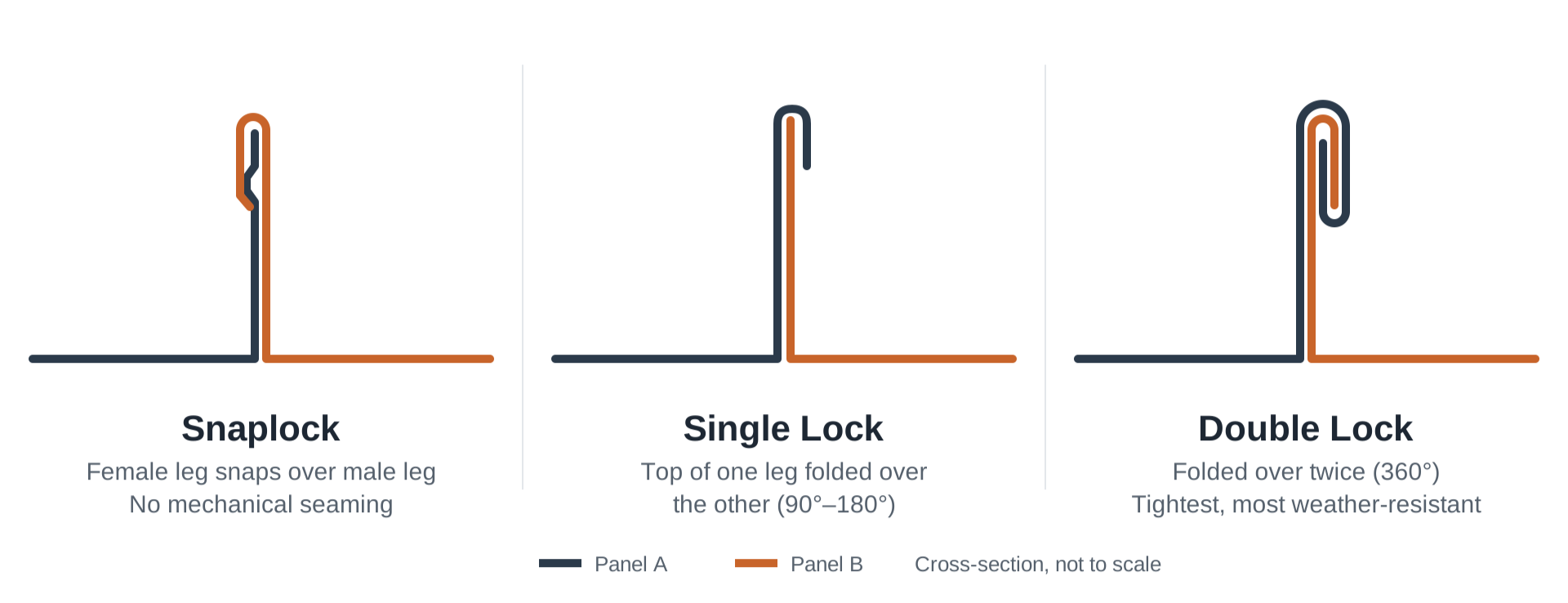
A snaplock seam closes by pressure and stays closed through the shape of the panel legs. A mechanical seam is crimped with a seaming tool that folds the legs together into a 90-degree (single lock) or 180-degree (double lock) seam. Here’s how the two compare on the points that affect a bid:
| Snaplock | Mechanical seam | |
|---|---|---|
| How the seam closes | Panel leg snaps over the adjoining leg | Panel legs are folded together with a seamer |
| Equipment to close the seam | Hand pressure (hand tools for details) | Hand seamers plus a powered seamer for full runs |
| Minimum slope | Typically steeper | Lower, especially double lock |
| Uplift and weathertightness | Lower than mechanical seam; varies by profile | Higher, with double lock at the top of the range |
| Long panel runs | Depends on the clip design | Common, with clips that allow thermal movement |
| Clips | One-piece snaplock clips, or a nail strip on some profiles | Fixed clips, plus two-piece expansion clips on longer runs |
| Install speed | Faster, no seaming pass | Slower, adds a seaming pass |
| Typical use | Residential and light commercial on steeper slopes | Low-slope commercial, long runs, high-wind sites |
Exact slope minimums and uplift ratings for any panel come from its manufacturer’s installation guide and tested assembly, so treat the table as a starting point.
How Snaplock Standing Seam Works
Snaplock panels have a male leg on one edge and a female leg on the other. The installer sets the next panel and presses the leg down until it engages, and the panel profile holds the seam closed. Many snaplock panels attach with concealed clips that hook over the leg before the next panel goes on. Some profiles use a nail strip instead, which is a fastening flange formed into the panel edge.
Where Snaplock Makes Sense
Snaplock fits steeper-slope residential and light commercial roofs with moderate panel lengths. It suits crews that don’t own or regularly rent a powered seamer, and schedules where install speed matters.
Where Snaplock Runs Into Limits
Because the seam isn’t folded, it depends on the panel’s engagement to resist wind and water. Many snaplock profiles call for a steeper minimum slope and carry lower uplift ratings than a comparable mechanically seamed panel. Low slopes, high-wind sites, and long runs are where those limits show up. When a job sits near the edge of a panel’s published range, confirm the tested assembly before you bid it as snaplock.
How Mechanically Seamed Standing Seam Works
Mechanical seam panels go down on clips, and then the legs are folded together. Crews start each seam and finish the ends and details with hand seamers, then run a powered seamer along the length of the panel. The fold holds the panels together mechanically instead of relying on a snap fit.
Single Lock vs. Double Lock Standing Seam
A single lock seam is folded 90 degrees. A double lock seam is folded 180 degrees, wrapping the legs around each other a second time.
Double lock gives the strongest resistance to wind uplift and water infiltration among the common standing seam options, which makes it the usual choice for low-slope roofs and demanding uplift specs. Single lock adds holding strength over snaplock without the second fold. It’s often used where the slope and exposure don’t call for a double lock.
Where Mechanical Seam Makes Sense
Mechanical seam earns its extra pass on:
- Low-slope commercial and industrial roofs
- Long panel runs, where clips have to let the panels move with temperature changes
- High-wind and exposed sites
- Projects whose specs call for a tested uplift rating or a specific warranty
Some profiles are designed to snap together and then be mechanically seamed for added performance. If you’re working with one, ask the manufacturer which closure the job’s slope and spec require.
Which Standing Seam System Holds Up Better in Harsh Weather?
On low slopes that see heavy snow, ice, or high wind, a mechanically seamed roof gives more protection at the seams, double lock in particular. On steeper slopes where snow sheds and water drains fast, a well-specified snaplock system can hold up well in any region. Slope and exposure matter more than location.
Snow and Ice
Melting and refreezing snow can build ice at the eaves and hold water on the roof. On lower slopes that water sits against the seams longer, which is where a folded seam has the edge.
Snow retention belongs in the same conversation. Seam-mounted snow guards attach with clamps such as S-5! clamps, and the clamp has to match the seam profile, so the seam decision carries into snow retention too. Our guide to snow retention systems for metal roofs covers the details.
Wind and Coastal Exposure
Coastal and hurricane-prone sites push uplift requirements higher, and many jobs there are specified around a tested uplift rating. That rating comes from the full tested assembly: panel, seam, clip type, clip spacing, and substrate.
Standards such as UL 580, UL 1897, and ASTM E1592 test the whole roof assembly, and commercial specs may also call for FM 4471. Jobs in Florida may also need state product approval or, in Miami-Dade and Broward counties, a Notice of Acceptance. A strong seam with the wrong clip spacing won’t deliver the rating on the data sheet. Check that the clip you order matches the clip type and spacing in the tested assembly. Each clip in AMSI’s clip lineup lists its size, gauge, and material.
Heat and Thermal Movement
A long steel panel grows and shrinks between a cold night and a hot afternoon, and summer sun in the Southeast drives wide daily swings in panel temperature. Clips that allow that movement keep stress off the seams and fasteners, as we explain in Why All Roofing Clips Aren’t Equal.
How Seam Type Changes Your Clips and Tools
The seam type sets the clip and tool decisions that follow. It’s also where small mismatches turn into callbacks, since the wrong clip usually looks fine on install day.
Clips
Snaplock systems use snaplock clips sized to the panel profile, or an integrated nail strip on some panels. Mechanically seamed systems typically use fixed clips, plus two-piece expansion clips on longer runs so the panel can move while the clip base stays put.
AMSI Supply has manufactured and supplied metal roofing products from Douglasville, Georgia, since 1993, including standing seam clips for both snaplock and mechanically seamed panel systems. Roofing 101: Types of Standing Seam Metal Clips walks through the basic clip types, and you can browse AMSI’s full clip lineup by panel system.
Tools
Both systems call for hand seamers and seaming pliers on details, terminations, and trim. A mechanically seamed roof also needs a powered seamer matched to the panel profile and seam type.
Crews that run mechanical seam a few times a year can rent a seamer, often through the panel manufacturer. Crews running it every week usually find that owning one pays off, which we cover in Beyond the Price Tag: Why Specialized Metal Tooling Is the Only Way to Scale.
Snaplock vs. Mechanical Seam: Where the Cost Difference Comes From
Mechanical seam usually costs more to install, and the gap builds up across the job. The seaming pass adds labor on every seam. The powered seamer is either a rental line on the bid or equipment the crew has to keep busy. Mechanically seamed panels and two-piece clips can also cost more than snaplock panels and one-piece clips, depending on the profile, and running a seamer cleanly at starts, ends, and transitions takes practice.
Company size changes the math. A 3-person crew that runs one mechanical seam job a season will likely price the rental and slower pace into that bid. A 15-person operation bidding low-slope commercial work every month is more likely to own the equipment and train every crew on it, spreading the cost across many jobs.
The cost to watch is the one that never makes it onto the bid. Snaplock only saves money when the roof sits inside its range, and outside it, one callback can wipe out the savings. For more on building these factors into your numbers, see Pricing Your Metal Roofing Jobs: A Strategic Contractor Guide.
How to Choose Between Snaplock and Mechanical Seam
Run through these questions before you bid:
- What is the roof slope, and how does it compare to the panel manufacturer’s published minimum for each system?
- How long are the panel runs, and how much thermal movement will the clips need to handle?
- What wind exposure does the site have, and does the spec call for a tested uplift rating?
- How much snow and ice will the roof see, and how well will it drain?
- What do the project spec and the panel warranty require?
- Does the crew have the equipment and experience for mechanical seaming, and does the schedule allow for it?
If slope, run length, and exposure all sit comfortably inside snaplock’s range, snaplock is usually the more efficient choice. If any of them push toward the edge, mechanical seam deserves a serious look.
Isn’t Mechanical Seam Always the Safer Bet?
It’s the stronger system, but extra strength the roof doesn’t need still shows up in the customer’s price. On a steep residential roof with short runs, a well-specified snaplock system is often the better value.
When to Check With the Manufacturer or Your Supplier
Make the call when a job sits near a slope or uplift threshold, when the spec names a performance requirement without naming a system, or when you’re mixing profiles on one project. The panel manufacturer can confirm what its tested assembly covers. Your supplier can confirm which clips and seaming tools match the panel before anything ships, and you can reach AMSI’s team through our contact page.
Snaplock vs. Mechanical Seam FAQs
Is mechanical seam better than snaplock?
For low slopes, long runs, and high-wind sites, yes. It offers higher uplift resistance and better weathertightness, especially as a double lock. On steeper residential roofs, snaplock usually delivers what the roof needs for less.
Is snaplock cheaper than mechanical seam?
Usually, yes. Snaplock skips the seaming pass and the powered seamer, which cuts labor and equipment costs. The savings only hold when the roof sits inside the panel’s rated slope, run length, and uplift range.
What is a double lock standing seam?
A double lock standing seam is a mechanically seamed panel whose legs are folded 180 degrees, wrapping around each other twice. It offers the highest uplift and water resistance among common standing seam options and is the usual choice for low-slope roofs.
What is the minimum slope for snaplock metal roofing?
It varies by panel profile and manufacturer. Many snaplock panels need a steeper minimum slope than mechanically seamed panels, so get the exact figure from the installation guide before you bid.
Do snaplock and mechanical seam panels use the same clips?
No. Snaplock panels use clips made for the snaplock profile, or a nail strip on some panels. Mechanically seamed panels typically use fixed clips and two-piece expansion clips matched to the specific profile.
Do I need a power seamer for mechanical seam roofing?
For full panel runs, yes. Hand seamers handle starts, ends, and details, but closing long seams by hand isn’t practical.
Can snaplock panels be mechanically seamed?
Some can. Certain profiles are designed to snap together and then be field-seamed for extra performance. Ask the panel manufacturer first, since a standard snaplock panel isn’t built to be folded.
Match the Seam to the Roof
For steeper roofs with shorter runs, snaplock is usually the efficient choice. Low slopes, long runs, exposed sites, and jobs with a tested uplift spec call for mechanical seam. Once the seam type is set, the clips and seaming tools follow from it, and the cost of a mismatch tends to surface after the crew has left.
Once you’ve made the snaplock vs. mechanical seam call, shop standing seam metal roofing clips from AMSI Supply. Not sure which clip matches your panel? Contact AMSI Supply with your panel profile and we’ll point you in the right direction.