
Metal Roofing Fasteners: How to Choose the Right Screw for Every Panel and Deck
A box of roofing screws is one of the smallest line items on a metal roofing job. A leak at an overdriven washer, or a row of screws backing out after two winters, can be one of the most expensive.
Choosing metal roofing fasteners starts with what the screw goes into and what it holds down. Get those right, along with the panel metal, the site’s exposure, and the manufacturer’s spec, and the screw type, drill point, coating, washer, and length follow.
How Do You Choose the Right Metal Roofing Fastener?
You choose a metal roofing fastener by working backward from the job. Start with the substrate and the panel system, check the panel metal for compatibility, factor in the climate, and then confirm against the manufacturer’s spec. The screw that fits all of those is the right one, even if it isn’t the one already on the truck.
The questions to answer first:
- What is the fastener going into: wood decking, wood purlins, light-gauge steel, or heavier structural steel?
- Is it fastening exposed-fastener panels, trim, or concealed clips under standing seam panels?
- What is the panel made of: galvanized steel, Galvalume, aluminum, or copper?
- Is the site coastal, high-humidity, or exposed to long freeze-thaw seasons?
- What fastener type, size, and pattern does the panel manufacturer specify for the warranty?
Treating screws as interchangeable is an easy habit to fall into on a busy job, and it’s behind a lot of avoidable leaks. The spec answers some of these questions outright. The sections below cover the rest.
Types of Metal Roofing Fasteners and When to Use Each
A typical metal roofing job uses a mix of fastener types, each matched to a different connection on the roof.
| Fastener | Typical use | Goes into |
|---|---|---|
| Self-drilling screw | Panels and trim on steel framing | Light-gauge or structural steel |
| Wood screw | Panels and clips on wood | Wood decking or wood purlins |
| Pancake head screw | Concealed standing seam clips | Wood deck or steel, under the panel |
| Stitch screw | Side laps and trim | Metal to metal |
| Pop rivet | Trim, flashing, and accessories | Metal to metal |
Self-Drilling Screws
A self-drilling screw has a drill point that cuts its own hole and forms threads in one step. It’s the standard choice for attaching panels and trim to steel purlins or framing, since it saves the crew a separate drilling pass. Self-drilling screws for metal roofing come in different drill point sizes for different steel thicknesses, which the drill point section below covers.
Wood Screws
Wood screws have a sharp point and coarser threads built to grip wood fiber. Use them when panels or clips fasten into plywood, OSB, or wood purlins. A screw built for steel usually doesn’t hold as well in wood, which can lead to back-outs.
Pancake Head Screws
A pancake head screw is a wide, low-profile screw used to fasten standing seam clips to the deck. The flat head lets the panel above sit flat without telegraphing a bump. For more on matching clips to the panel, see Roofing 101: Types of Standing Seam Metal Clips, or browse AMSI’s standing seam metal roofing clips.
Stitch Screws and Pop Rivets
Stitch screws are short fasteners that join metal to metal at side laps and trim, where there’s no framing behind the connection. Pop rivets for metal roofing do similar work on trim, flashing, and accessories where a clean, flush connection looks better or a screw can’t be driven. Setting them takes a rivet tool sized to the rivet, so check the crew’s riveting tools before the job. For both, the material should be compatible with the panel, which matters most on aluminum and copper.
Self-Drilling vs. Self-Tapping Screws
A self-drilling screw drills its own pilot hole. A self-tapping screw forms threads but needs a pre-drilled hole. The terms get mixed up at the counter, so confirm the point type before ordering, because a self-tapping screw on a job planned for self-drilling adds a drilling step to every fastener.
How to Match the Fastener to the Job
Drill Point and Substrate
On self-drilling screws, the length of the drill point decides how much steel it can cut through before the threads start to engage. If the steel is thicker than the point is rated for, the threads hit metal before the hole is finished, and the screw can bind, stall, or snap. Fastener manufacturers publish charts that match each point size to a steel thickness range. AMSI’s fastener data sheets include drill point and material thickness details for many of the screws we carry.
Match the point to the steel. Check the drill point chart against the actual thickness of the purlins or framing, and confirm it before the order goes in.
Material and Coating
Most roofing screws are either coated carbon steel or stainless steel. Coated carbon steel is the common choice on galvanized and Galvalume panels. Stainless costs more and is often specified for aluminum or copper panels, coastal sites, and other high-corrosion settings, which are the jobs where stainless steel roofing screws are worth the extra cost.
The reason is galvanic corrosion. When two different metals touch in the presence of moisture, one can corrode faster than it would on its own. That’s why the panel manufacturer’s guidance on compatible fastener materials should have the final word. Our post on how to avoid rust on a metal roof covers more of the corrosion side.
Sealing Washers
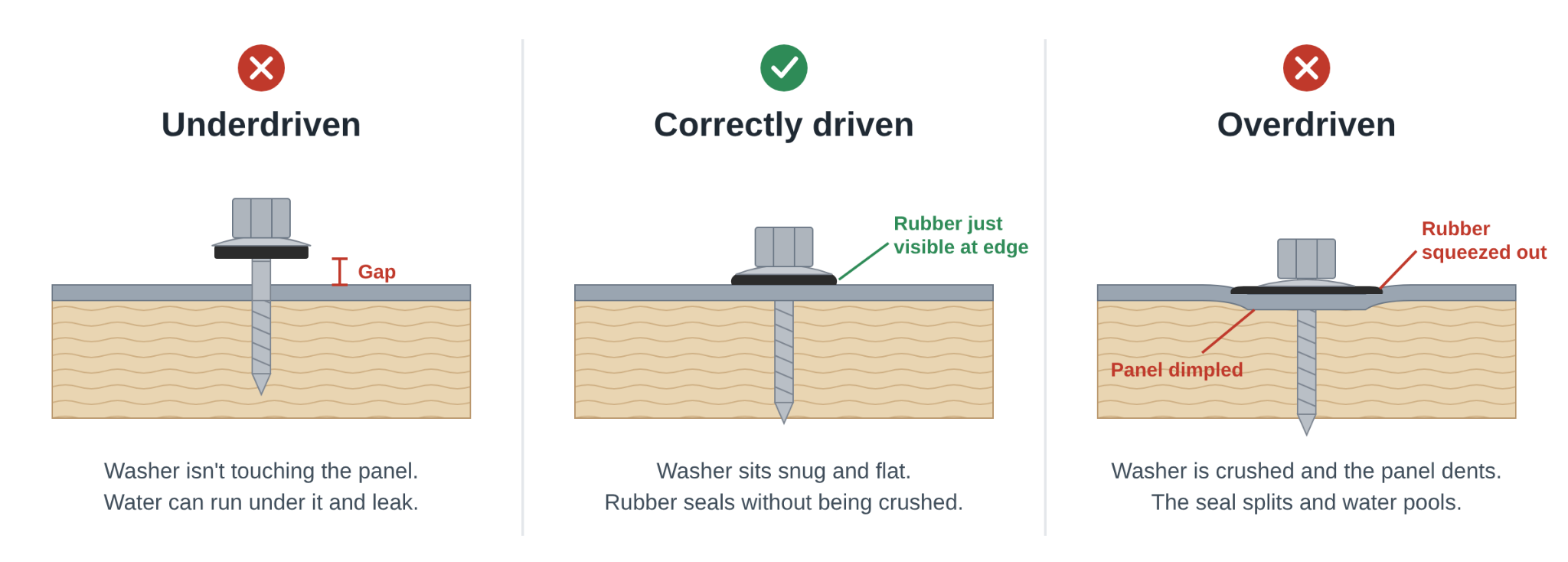
On exposed-fastener panels, the sealing washer keeps water out at every screw. The common design is an EPDM rubber washer bonded to a metal backing. Driving depth decides whether it works. A properly driven washer is snug and slightly compressed. Overdriving splits the washer or squeezes it out past the edge of its backing, and underdriving leaves a gap that water can follow.
Length
The screw has to pass through the panel and any insulation, underlayment, or spacer, then still reach full engagement in the substrate. Add up everything between the screw head and the structure before choosing a length, and use the manufacturer’s minimum embedment as the floor.
Color Matching
Exposed fasteners show on every visible elevation. Painted heads matched to the panel color keep the finished roof looking clean, and homeowners and building owners notice when they don’t match.
What Causes Metal Roofing Screws to Leak or Back Out?
Many fastener leaks trace back to selection and installation rather than a defective screw. The usual causes:
- Washers driven too tight or too loose
- A drill point that doesn’t match the steel thickness, leaving a stripped or oversized hole
- A screw too short to reach full embedment after insulation or underlayment
- Fasteners that miss the purlin or framing member entirely
- Thermal movement on long panel runs working exposed fasteners loose over time
Wide temperature swings make the last one harder to ignore. Summer heat on a dark panel and winter freeze-thaw cycles push and pull on every exposed fastener for years. That’s one reason many longer-run roofs use standing seam panels on concealed clips, which let the panel move without stressing a screw through it. Why All Roofing Clips Aren’t Equal explains how clip design handles that movement.
These problems tend to surface a season or two after the job is closed out. If you want the full picture of what a fastener failure costs in callbacks and warranty risk, read Fasteners: The Hidden Heroes of a Metal Roof That Lasts.
Before You Order: A Metal Roofing Fastener Checklist
Confirm these before the order goes in:
☐ Substrate type and thickness
☐ Panel system, with the manufacturer’s fastener spec on hand
☐ Fastener material and coating compatible with the panel metal
☐ Drill point matched to the steel thickness, or a wood screw for wood
☐ Length that covers the panel, insulation, and underlayment plus full embedment
☐ Washer type and head color
☐ Quantity from the manufacturer’s fastening pattern, with overage for waste
On quantity, note that many fastening patterns call for tighter spacing at edges and corners, where wind loads run higher, so an estimate based on field spacing alone will come up short.
Crew size changes how you use the list. A 3-person crew ordering per job can run through it at the counter in a few minutes. A 15-person operation gets more out of standardizing approved fasteners for each panel system it installs, so every crew drives the same screw on the same roof and installs stay consistent from one job to the next.
When to Ask Your Supplier
Ask before ordering when the substrate is unusual, when metals are mixed on one roof, when the site is coastal, or when the spec doesn’t clearly name a fastener.
A supplier who knows the product line can match the screw to the job before it ships, which is faster than finding the problem on the roof. AMSI Supply, based in Douglasville, Georgia, has manufactured and supplied metal roofing products since 1993, including standing seam clips, fasteners, sealants, and installation tools for metal roofing contractors. Our team is available through our contact page.
Metal Roofing Fastener FAQs
What screws do you use for metal roofing?
Self-drilling screws for steel framing, wood screws for wood decks and purlins, and pancake head screws for standing seam clips. Exposed screws need a sealing washer, and trim connections often use stitch screws or pop rivets.
How long should metal roofing screws be?
Long enough to pass through the panel and anything under it, then reach the manufacturer’s minimum embedment in the substrate. The right length changes with insulation and underlayment thickness, so measure the full assembly.
Are stainless steel screws better for metal roofing?
For aluminum or copper panels, coastal sites, and other corrosive settings, stainless is often the better choice. On galvanized or Galvalume panels in typical conditions, coated carbon steel screws are common and usually cost less. Check the panel manufacturer’s compatibility guidance either way.
Do standing seam roofs use exposed fasteners?
The panels themselves are held by concealed clips, fastened with pancake head screws under the panel. Exposed fasteners still show up at trim, flashing, and some panel ends.
Can I reuse metal roofing screws?
It’s generally not recommended. Sealing washers compress and age, and threads wear once they’ve been driven, so a reused screw may not seal or hold the way a new one does.
Order the Screw the Roof Calls For
The right fastener comes out of the job’s details: what it goes into, what it holds, what metal it touches, and what the spec requires. Settle those first and the screw type, point, coating, washer, and length follow. A single “roofing screw” won’t cover every panel and deck, which is why it pays to order from a supplier that knows the difference.
Have a panel, deck, or exposure that doesn’t fit the usual answer? Send AMSI the specs and we’ll help you work out which fastener the job calls for. When you’re ready, shop metal roofing fasteners from AMSI Supply or talk to our team about your next order.